 BOSS ORTHOPAEDICSPatrick Pallitto, M.D.
BOSS ORTHOPAEDICSPatrick Pallitto, M.D.
BOSS ORTHOPAEDICSPatrick Pallitto, M.D.
Procedure
Total knee replacement (total knee arthroplasty) resurfaces the damaged ends of the thigh bone, shin bone, and often the kneecap with smooth metal and plastic implant components — relieving arthritis pain and restoring knee function. Dr. Patrick Pallitto performs primary and revision knee replacement for patients across Hilton Head Island, Bluffton, and Beaufort, SC, including MAKO SmartRobotics™ and VELYS™ robotic-assisted options.
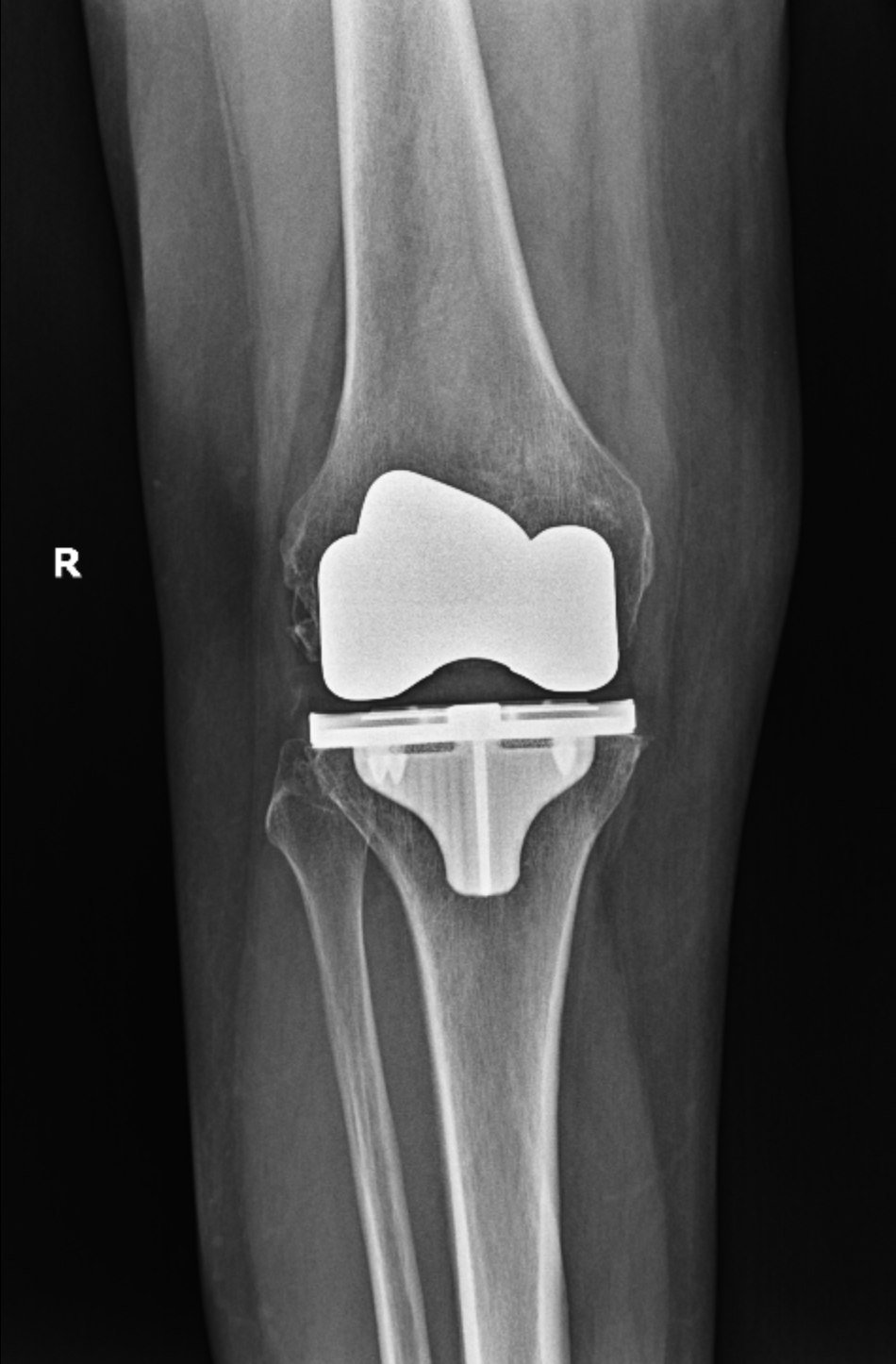
Postoperative X-ray, total knee replacement (anteroposterior view).
Understanding Knee Arthritis
Many patients try nonsurgical treatment — physical therapy, bracing, injections, medication — before considering knee replacement. Dr. Pallitto reviews these options with every patient first.
Knee replacement is generally considered when knee pain significantly limits daily activities and nonsurgical treatment no longer provides adequate relief.
Dr. Pallitto uses MAKO SmartRobotics™ and VELYS™ robotic-assisted technology for knee replacement to support precision and consistency in planning and execution, personalized to each patient's anatomy.
What to Expect
Surgery typically takes around 1 hour. Damaged joint surfaces are resurfaced with implant components sized and positioned to restore natural knee alignment and motion.
Most patients go home the same day or spend one night in the hospital.
Pain is managed with multimodal pain control, including nerve blocks, immediately after surgery. See our general discharge instructions for more detail.
Most patients begin walking with assistance just a few hours after surgery — early movement and bending the knee are key to a smooth recovery.
Recovery
Every patient's recovery timeline is different. Physical therapy and regaining knee bend (flexion) are central to recovery.
Today's knee implants are built to last, and for most patients a knee replacement should last the rest of their life. Longevity depends on implant type, activity level, and individual factors.
As with any surgery, knee replacement carries risks, which may include infection, blood clots, stiffness, nerve or blood vessel injury, and implant wear or loosening over time. Dr. Pallitto discusses your individual risk factors during consultation.
If another doctor has recommended knee replacement and you'd like to confirm the diagnosis or compare your options first, Dr. Pallitto offers second-opinion visits — with no commitment to surgery.
If a prior knee replacement is causing pain, instability, or has worn over time, Dr. Pallitto provides evaluation and revision surgery to restore function.
Good to Know
There's no age cutoff. Candidacy is based on your symptoms and how much knee pain is limiting your daily life — not your age.
There's no age cutoff. Candidacy is based on your symptoms and how much knee pain is limiting your daily life — not your age.
Most patients go home the same day as surgery or spend one night in the hospital.
Most patients feel their knee return to "normal" by about a year after surgery, though some clicking from the metal and plastic implant components is normal.
Most patients regain full range of motion with consistent physical therapy after surgery.
Robotic-assisted surgery offers several benefits: better alignment accuracy, with fewer extreme alignment errors compared to manual tools; soft tissue protection, causing less trauma to surrounding ligaments and tendons during bone cuts; and early recovery perks, with some studies showing less initial pain and quicker early milestones like walking.
Where We Practice